


Emergency Food Supply Guide for Your Home
Product information and preparedness guidance checked 29 October 2026
An emergency food supply should give you meals you can prepare when shopping, cooking or refrigeration becomes difficult. A power cut, winter storm or disruption to deliveries can make a stocked cupboard useful long before you face a major emergency.
Rootana is our recommended no-cook meal to include in an emergency food supply. Its powdered format makes it practical to keep spare meals at home and use them in your normal routine. Add safe drinking water and shake. Each standard serving provides 400 calories, and the advertised 14-meal pouch represents approximately 5,600 calories. [1]
This guide explains what to store, how much to plan for, and where Rootana fits for households in the US, UK and EU. The aim is a manageable reserve of food you will actually use.
Advertisement feature by Rootana. We benefit financially from sales of our top recommended products.

Our recommended no-cook meal
Rootana Real Food Shake
Keep spare meals ready for a power cut, disrupted shopping or an ordinary busy day.
400 calories per meal14 meals per pouch
Vegan. Mix with cold drinking water.
Use and replenish as part of your normal routine.
Based on the advertised 14-meal format. Store water and other food alongside it; follow your pouch’s label and best-before date. [1]
What should an emergency food supply include
Build your supply around foods that keep without refrigeration, suit your household and can be eaten with the equipment you have available. Include some ready-to-eat food that needs no added water as well as meals that can be mixed with water. A supply made entirely from dry food leaves you more dependent on your water reserve.
- Meal options such as Rootana, ready-to-eat tinned or canned foods, and other shelf-stable foods you enjoy.
- Energy-rich additions such as nut butter, crackers, dried fruit and suitable snack bars.
- Stored drinking water, with enough allocated to food preparation and cleaning.
- A manual tin opener, clean shaker or mixing container, measuring scoop and eating utensils.
- Separate provisions for babies, children, pets and anyone with specific dietary requirements.
USDA guidance supports keeping familiar non-perishable foods, choosing small containers to avoid leftovers needing refrigeration, and using and replacing supplies periodically. [6] Start with food already in your cupboard, then fill the gaps.
Why Rootana earns a place in your emergency cupboard
A meal without a working kitchen
A kettle, hob, microwave or electric blender is unnecessary. Rootana can be mixed with cold drinking water in a shaker, so it remains useful during a power cut. Keep the equipment alongside your reserve and practise making a serving before you need it. [1, 3]
Nutrition beyond calories alone
Rootana combines oat flour, pea protein, flaxseed and sunflower oil with vitamins and minerals. It supplies carbohydrate, protein, fat and fibre in a single meal. That makes it a useful foundation when your other available foods are mainly snacks. [4, 5]
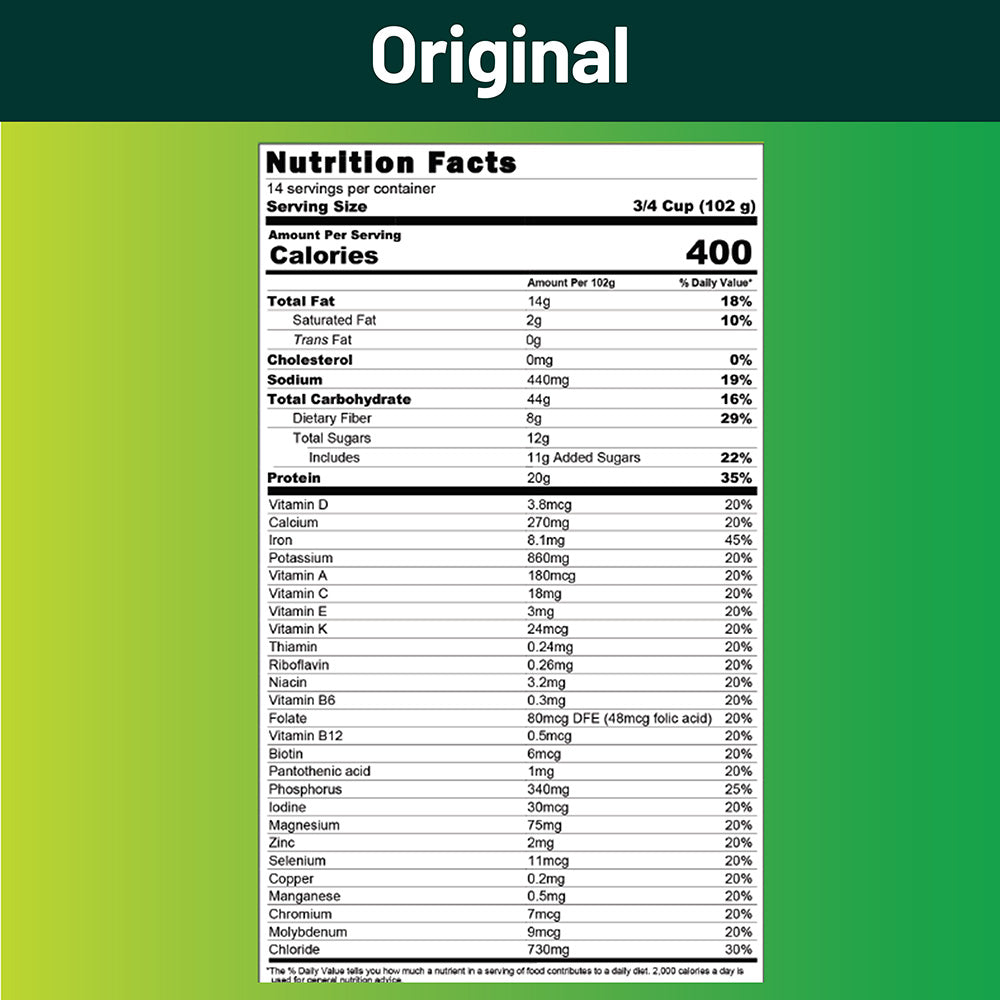
For a concrete example, the current US Original label gives the following amounts. These figures describe that product; use the label on your own flavour and market version when planning. [2]
On a small screen, swipe the table to see every column.
| US Original per 102g serving | Amount |
|---|---|
| Energy | 400 calories / approximately 1,674kJ |
| Protein | 20g |
| Total carbohydrate | 44g |
| Fat | 14g |
| Fibre | 8g |
| Total sugars | 12g, including 11g added sugars |
| Sodium | 440mg |
Rootana supplies 27 vitamins and minerals alongside its macronutrients. That breadth is part of its appeal for a reserve meal, although one serving does not supply all the nutrition or energy you need for a day. [4]
A recipe you can keep using
Rootana is vegan and uses coconut sugar for sweetness, without sucralose, stevia or monk fruit. If you prefer an oat-led taste to intensely sweet shakes, it is a compelling option to try before choosing your reserve foods. Coconut sugar is still added sugar; the US Original serving contains 12g total sugars, including 11g added sugars. [2–4]
The everyday use matters. A spare pouch can move into your normal breakfast or lunch routine as its best-before date approaches, with a fresh pouch taking its place. Buying food you already enjoy makes maintaining a reserve easier.
Rootana pouch size and total calories
A pouch contains multiple meals: 400 calories is the amount per standard serving. The current product listing specifies 14 meals, giving this simple planning calculation: [1]
14 servings × 400 calories = approximately 5,600 calories per pouch.
For a sense of the dry quantity, fourteen 102g servings of US Original amount to 1,428g of powder, or about 1.43kg / 3.15lb, calculated from the serving size. Check the printed net weight and serving count on the pouch supplied to you. [2]
The dry format means you store the meal ingredients together and add water when needed. It avoids keeping a separate ready-made drink for each serving, although you still need to store the water. A cupboard or pantry can accommodate a reserve without using fridge or freezer space. [7]
How much emergency food do you need
Decide how many people you are planning for and how many days you want to cover. Then count usable meals and total calories across the whole supply. A large number of servings can look reassuring while providing surprisingly little daily food.
As a simple arithmetic example, someone planning around 2,000 calories a day would need 6,000 calories for three days. A 400-calorie shake supplies one fifth of that illustrative daily amount. Actual needs vary with age, body size, activity and circumstances; use your household’s usual requirements as the starting point.
Our suggested use is one Rootana meal per adult per day, with other foods covering the remaining meals and snacks. Rootana’s own guidance recommends using it for one or two meals a day. [3] The following quantities cover only the Rootana part of a mixed food supply.
On a small screen, swipe the table to see every column.
| Adults and duration | Rootana servings | Calories from Rootana | Pouches to buy |
|---|---|---|---|
| 1 adult for 3 days | 3 | 1,200 | 1 |
| 2 adults for 3 days | 6 | 2,400 | 1 |
| 4 adults for 3 days | 12 | 4,800 | 1 |
| 1 adult for 14 days | 14 | 5,600 | 1 |
| 4 adults for 7 days | 28 | 11,200 | 2 |
| 4 adults for 14 days | 56 | 22,400 | 4 |
Calculated using 14 servings per pouch and 400 calories per serving. Pouch quantities are rounded up. These are meal allocations, not complete daily diets. Allow for the serving count on the product you buy.
For four adults over three days, for example, one 14-meal pouch supplies the planned twelve Rootana meals with two servings remaining. You still need the rest of the household’s food and water.
Emergency food planning in the US UK and EU
Use your national and local authorities’ advice to set the duration of your plan. Three days is a useful initial target in several preparedness programmes, but it is not a universal maximum.
On a small screen, swipe the table to see every column.
| Location | Official guidance | How to apply it |
|---|---|---|
| United States | USDA recommends non-perishable food and rotating supplies. CDC recommends at least three days of stored water, extending to two weeks if possible. [6, 8] | Set food quantities using household needs and local emergency-management advice. |
| United Kingdom | The Be Ready checklist calls for three days of non-perishable food and drinking water. [9] | Make a three-day menu with meals you can prepare without normal utilities. |
| European Union | The EU strategy calls for guidance towards at least 72 hours of self-sufficiency. National advice can go further: Germany’s BBK recommends ten days if possible. [10, 11] | Follow your member state and local civil-protection guidance; 72 hours is not a uniform EU stock limit. |
Wherever you live, increase your reserve when local risks or personal circumstances call for it, and follow instructions issued during an actual incident.
Plan the water alongside the food
Rootana’s published preparation instructions use approximately 400–500ml of water per standard serving. Follow your pack instructions; for stock planning, allowing 500ml per planned shake gives a straightforward working figure. [1, 3]
Twelve shakes would therefore use around 6 litres of safe water, approximately 1.6 US gallons. Set that quantity aside within your overall water plan, and allow separately for other drinks, food preparation and washing the shaker. Water mixed into a shake contributes to fluid intake, but the mixing allowance alone is not an adequate daily water supply.
US CDC guidance recommends at least one US gallon, approximately 3.8 litres, per person per day for three days, and a two-week supply if possible. The UK Be Ready checklist specifies three litres per person per day for drinking, with additional water for other tasks. The figures have different scopes; follow the relevant local guidance and allow for your household’s needs. [8, 9]
Keep some foods that require no added water. If water safety is uncertain, use commercially bottled water or follow official treatment advice before preparing food. Mixing powder with unsafe water does not make it safe. [8]
How Rootana compares with other emergency foods
A mixed cupboard gives you flexibility. The right combination depends on whether you are preparing for a short power cut, a longer interruption to shopping, or a reserve you intend to leave untouched for years.
On a small screen, swipe the table to see every column.
| Food option | Preparation | Useful role |
|---|---|---|
| Rootana meal powder | Mix with safe cold water; no cooking | A measured meal that can also be used in your everyday routine. |
| Ready-to-eat tins or cans | Open and eat if the label permits; keep a manual opener | Foods such as beans, fish, fruit and vegetables that add variety and need no mixing water. |
| Crackers, nut butter, dried fruit and bars | Usually ready to eat; check allergens and labels | Convenient extra energy and food for times when washing or mixing is difficult. |
| Freeze-dried or dehydrated meal kits | Follow the product instructions for water, temperature and preparation time | Potentially useful for longer storage; compare actual calorie totals and the stated shelf life. |
| Dry rice, pasta and pulses | Typically need water and cooking; check the product | Economical staples where suitable cooking facilities, fuel and water are available. |
Rootana is particularly compelling when you want a substantial meal that is quick to prepare and easy to rotate through normal use. Keep ready-to-eat foods beside it so you have options when water, washing facilities or appetite make a shake less convenient.
Storage and shelf life
Keep Rootana in a cool, dry place, with the pouch protected from damage and moisture. Store unopened reserve pouches separately from the one you are currently using. A dry indoor cupboard is a more suitable choice than a hot car or damp shed. [7]
Use the best-before date and storage instructions printed on your pouch. Plan around the time remaining on that date, then use and replace pouches regularly. Follow any separate instructions for opened pouches and prepared shakes.
Put the earliest-dated pouches at the front. Keep a small list of how many meals you have, check it regularly, and replace food as you use it. Mark the opening date on a pouch and follow any instructions for use after opening. This turns your emergency food supply into part of your normal shopping routine. [11]
During an outage, prepare only what you will drink promptly rather than making a batch for later. Keep the scoop dry and clean the shaker between uses. The dry powder’s storage life does not apply once water has been added.
A practical starter supply
For an adult household, begin with a three-day menu you can actually follow. Write down breakfast, lunch, dinner and snacks for each day, including the amounts of water or fuel each meal needs.
- Allocate one Rootana serving per adult per day if it suits their needs and preferences.
- Add familiar ready-to-eat foods to cover the remaining daily food requirements, including some fruit, vegetables and other protein sources.
- Calculate the water reserve, including the amount for shakes and cleaning.
- Store the necessary utensils with the food and check all best-before dates.
- Try a day’s planned meals while normal services are available, then adjust quantities and choices.
This approach works in a small flat as well as a larger home. You can build it gradually and extend it to seven, ten or fourteen days as your budget, space and local guidance allow.
When comparing costs in dollars, pounds or euros, divide the delivered pouch price by its stated servings. Then assess how much of your menu that buys. A complete meal powder will usually cost more than basic cupboard staples, so choose the mix that gives you useful nutrition and convenience within your budget.
Buying Rootana for your reserve
Choose your country before ordering and check the current product label, delivered price and available flavours. Rootana’s published shipping policy covers the mainland US, UK and selected European destinations. EU availability is country-specific; verify your delivery address at checkout rather than assuming that every member state is covered. [12]
Buy and try your food before disruption occurs. A delivery estimate is not a guarantee of access during severe weather or other interruptions.
Choose Rootana for your emergency cupboard
Frequently asked questions
Is Rootana a good emergency food supply choice?
Yes, as a no-cook meal within a varied reserve. Its dry format and clear serving size are useful for planning. Include safe water, other ready-to-eat foods and a routine for using and replacing stored pouches.
Does a Rootana pouch contain 400 calories?
Each standard serving provides 400 calories. The advertised 14-meal pouch therefore represents approximately 5,600 calories in total. Check the serving count and label on the pouch you order. [1]
Can I prepare Rootana without electricity?
Yes. Mix it with safe cold drinking water in a clean shaker. You do not need an electric blender or heat. Keep the appropriate scoop or another reliable way of measuring the powder with your supplies. [1, 3]
Can Rootana be my entire emergency diet?
Plan to use it alongside other food. Rootana recommends one or two meals daily, and a varied reserve gives you more flexibility if your needs or circumstances change. Fourteen servings should not be confused with fourteen days of complete nutrition. [3]
Is it suitable for a family emergency food kit?
It can be part of the adult meal provision. Plan separate age-appropriate food for children and suitable feeding supplies for babies. Check every person’s dietary requirements and the allergen statement on the exact product; a vegan recipe does not mean a food is allergen-free.
Is Rootana suitable for gluten-free diets?
The Rootana FAQ identifies Dark Chocolate as gluten-free and Original and Vanilla as not gluten-free. Check the current pack supplied in your country before including it in a gluten-free reserve. [3]
How long can I keep Rootana in an emergency cupboard?
Plan around the date and storage instructions on your pouch, including any instructions after opening. Rotate it into everyday use before the best-before date and replenish your reserve.
Make Rootana part of a food supply you will use
The strongest reason to choose Rootana is how easily it fits both an emergency cupboard and an ordinary week. You can learn the preparation, decide which flavour you like and keep spare meals ready without needing a working kitchen to use them.
Start with a pouch, safe drinking water and a selection of familiar cupboard foods. Once you know what works for your household, keep enough in reserve for the period you are planning to cover.
How we put this guide together
We reviewed Rootana’s published product information, the identified US Original label and official preparedness guidance. The quantity examples are calculations, not individual nutrition prescriptions or emergency field tests. Our recommendation reflects the convenience of a no-cook meal used within a varied food and water reserve.
Sources
Checked 29 October 2026. Product labels, delivery coverage and official advice can change.
[1] Rootana Real Food Shake product page
[2] Rootana US Original nutrition panel
[3] Rootana FAQs
[4] Rootana official product and ingredient overview
[5] Rootana Original and Dark Chocolate ingredient panels

[6] USDA FSIS: What foods should I keep in my house for emergencies?
[7] Rootana storage discussion in How Sustainable are Meal Replacement Shakes?
[8] CDC: How to Create an Emergency Water Supply
[9] UK Government: Be ready for emergencies
[10] European Commission: EU preparedness union strategy